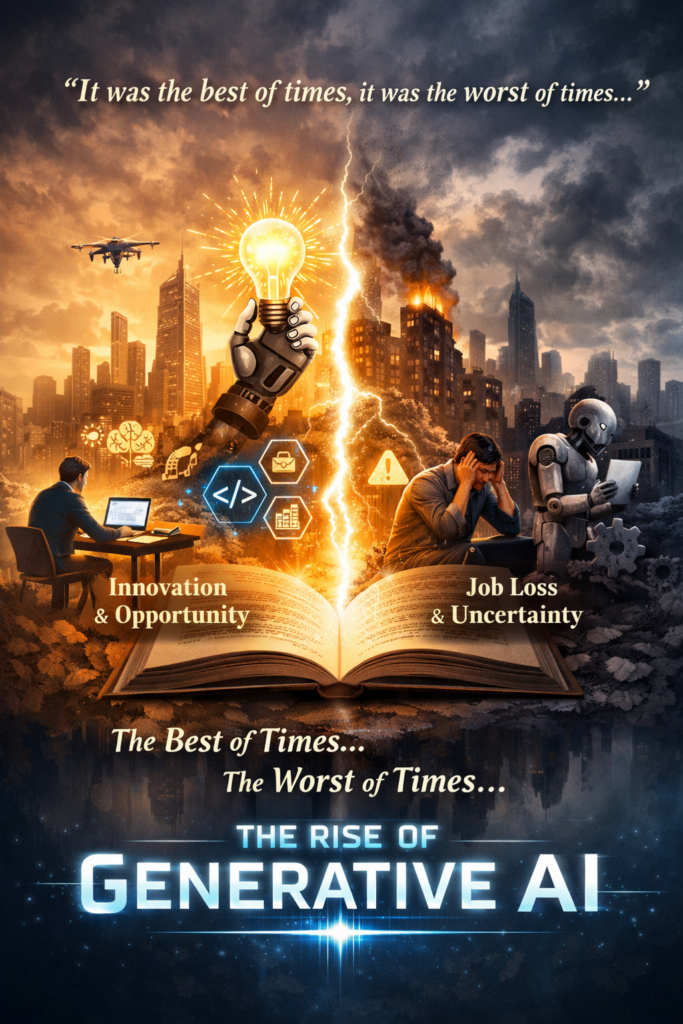
Charles Dickens opens A Tale of Two Cities with one of the most quoted passages in literature:
It was the best of times, it was the worst of times, it was the age of wisdom, it was the age of foolishness, it was the epoch of belief, it was the epoch of incredulity, it was the season of Light, it was the season of Darkness, it was the spring of hope, it was the winter of despair, we had everything before us, we had nothing before us, we were all going direct to Heaven, we were all going direct the other way.
This passage endures because it captures a recurring paradox of human history: periods of great progress are often accompanied by deep uncertainty and disruption. Although Dickens was writing about the French Revolution, the sentiment extends far beyond that era.
We are living through a similar moment today with the rise of Generative AI and large language models (LLMs).
The Wrong Comparison
Many compare this shift to the rise of mobile phones two decades ago. But that analogy falls short. Mobile technology primarily extended and augmented existing experiences. It made communication faster, services more accessible, and products more portable. Generative AI, by contrast, is fundamentally reshaping how humans interact with software itself. It is not just improving interfaces; it is redefining them.
Two Camps, One Certainty
This transformation has split opinion into two broad camps.
One camp views GenAI as a threat. In this view, programmers, writers, and digital creators risk becoming obsolete as machines generate code, text, and media on demand. If content can be produced instantly at near-zero cost, what role remains for human creators?
The other camp takes a more evolutionary perspective. Here, GenAI is seen as a productivity multiplier rather than a replacement. Programmers can tackle more complex problems. Writers can focus on higher-level thinking and storytelling. Creators can explore a broader “long tail” of ideas that were previously too costly or time-consuming to pursue.
Both camps, however, agree on one thing: disruption is real, and it is accelerating.
The Expanding Frontier
And yet, disruption is only one side of the story.
Every technological shift that lowers the cost of creation expands the frontier of innovation. Generative AI has the potential to democratize access in ways we are only beginning to understand. Just as mobile phones brought digital services to populations without access to desktops, GenAI can make technology accessible to those who struggle with traditional interfaces like text or code. Voice interaction, auto-translation, and large-scale personalization can bring education, communication, and creativity to entirely new audiences.
The possibilities are vast.
This is where Jevons Paradox becomes relevant. The paradox suggests that increased efficiency leads not to reduced consumption, but to greater overall usage.
Software development has historically been expensive. Content creation has been labor-intensive. As Generative AI reduces these costs, we should expect an explosion and not a contraction of software and content. More ideas will be tested. More experiments will be run. More niche problems will be addressed.
This, in turn, accelerates innovation.
What Changes Now
There was a time when a small group of engineers working out of a garage could challenge established companies. Today, even that barrier is falling. A single individual, equipped with the right tools, can build, iterate, and compete at a scale that was previously unimaginable.
What matters now is not just technical skill, but creativity and the willingness to experiment.
The Paradox Holds
In that sense, Dickens’ words feel as relevant as ever.
We are, indeed, living in the best of times and the worst of times; an age of extraordinary possibility, paired with profound uncertainty.